Most often, students learn limits rigorously using the epsilon-delta definition. However, quite a few textbooks use or promote an alternative approach (Richmond 1959; Kuratowski 1961; Carpio 1995; Spleight 2016). One such approach involves sequences. For me, this approach is closer to how limits are usually introduced intuitively, though I am not necessarily endorsing this approach—I just want to show how things could be done differently.
First we define what we mean by a sequence.
Definition 1 A sequence is a function whose domain is the set of natural numbers; that is, for some subset . The elements of are called the terms of a sequence.
Thus, we do not consider finite sequences with only a finite number of terms.
For example, consider the list 1, 1.01, 1.001, 1.0001, … and so on. If we define the function so that it assigns the th natural number to the one with 0’s in the list (, , … and so on), then is a sequence. Typically we use the notation instead of for the terms of the sequence, and for the sequence itself.
Intuitively, we can “define” the limit of a sequence to be the value that it approaches as approaches infinity or . For some sequences, the limit is obvious. For instance, it is clear that the sequence or approaches 0 as increases without bound. Similarly, it can be seen using a table of values that as ,
For other sequences though, the limit is not as obvious. Take the sequence
Does this sequence eventually approach 1, 0 or 1/2 as a compromise?
A natural way of answering this is through error bounds. To help, we introduce a new definition:
Definition 2 A statement holds for sufficiently large or for large iff there exists a positive integer such that for every natural number , is true.
Consider the statement For small , like , it is false (). However, for every larger than 10, the expression on the right “overtakes” the one on the left; thus the inequality holds true. We can therefore pick so that the statement above is true. Therefore, holds for large ().
Limits of Sequences
Definition 3 A sequence converges to iff there exists a real number such that for each positive , there is a corresponding such that for large ,
holds. We write this as
We also say that the limit is .
This inequality says that the distance between each and is no greater than (Recall that the distance between two real numbers and is given by ).
Illustration
We can illustrate this definition by as follows. Take the sequence
again, which we intuitively guessed its limit to be 0. Suppose that . That is, the distance between and must be less than 0.25. Below is the graph of the sequence in blue:
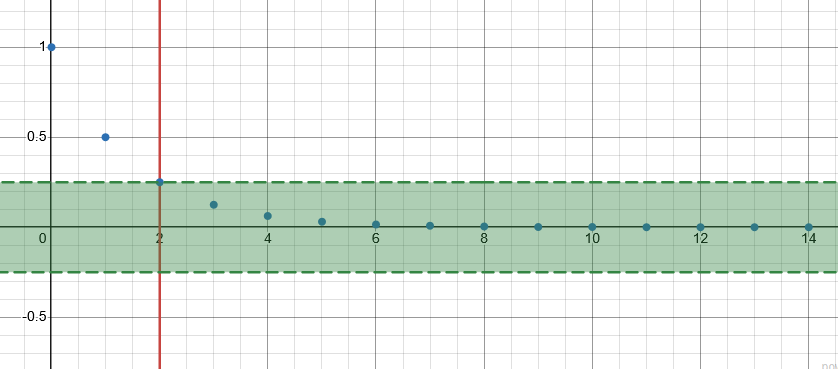
The green area represents all points [not just ] that satisfy our inequality; that is, all points inside the graph of . Notice that this is so for all sequence points beyond the red line. In other words, all values of satisfy for all , . If we make smaller, say , we suddenly find that is too small to make all the blue dots to fit inside the green area:
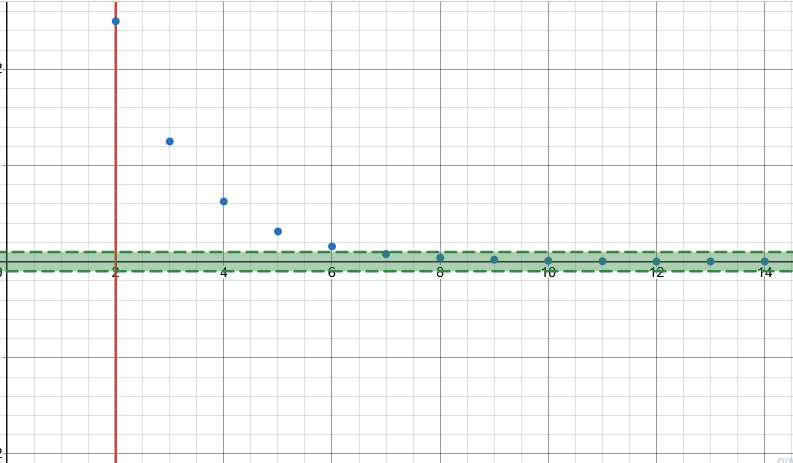
Therefore, if the limit is indeed 0, we must find a sufficiently larger that makes the inequality true. Picking does the trick:
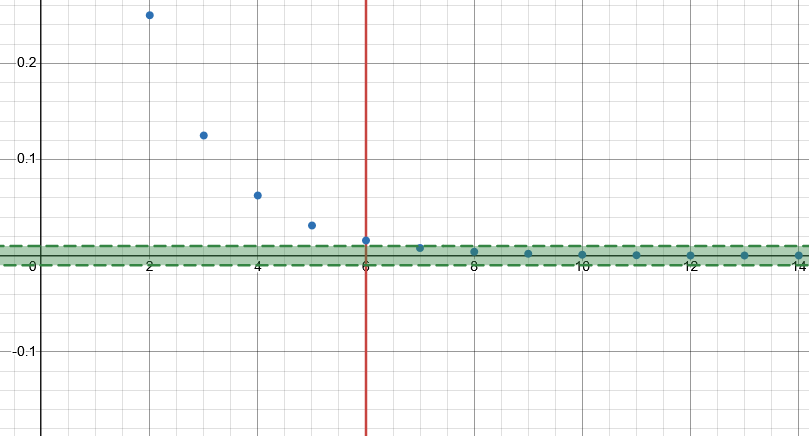
Now all the blue dots are in the green area; that is, for all , < 0.01$. For illustration, .
However, this illustration does not prove that the limit is actually 0. We show the rigorous proof below:
Proof
Proof Let . By the Archimedean property, there exists such that , or . For all , if , . Furthermore, for , thus (this can be shown by either induction or Bernouili’s inequality). Therefore,
(Note that we can get rid of the absolute value sign since we’re dealing with positive real numbers anyway). This completes the proof.
Proof of the Addition Law
The following theorems will be useful in proving limits of sequences, which we will not prove here:
Theorem 4 (Triangle Inequality) For any real numbers and ,
Corollary For any real numbers and ,
We are now able to prove this obvious theorem for limit addition:
Theorem 5 (Addition Law) Let and be sequences. If and , then .
Proof Let . It follows that is also an arbitrary positive number. Since and are convergent, there exist and such that for all
and for all ,
respectively.
We choose to ensure that both two inequalities above hold. By the triangle inequality,
The proof for the multiplication law is more complicated though. I’ll leave the proof for the other laws for part 2.
Limits of General Functions
We can now define the limit of a function in terms of a sequence:
Definition 6 Let be a real-valued function with real domain . Let be a real number with a sequence converging to it that satisfies for all (In other words, is a limit point of ).
Then the limit of the function is a real number iff all sequences } converging to with each satisfy
We denote this as
We remark a few things.
Remarks
We added the restriction that all sequences must satisfy since we want to study the behavior of near , not at . Supppose we did not. We define a function such that
We intuitively guess that should be 0 (). For that to be true, all sequences in the domain of that converge to 1 must satisfy as well. We are then allowed to use the constant sequence which converges to . But by our modified definition, , which doesn’t make sense.
Similarly, we require that be a limit point of , since we could also define a function something like and . I could then say that which is absurd, but vacuously true.
There’s also an interesting approach by Marsden that does away with limits altogether; but that’s a topic for another post.
I’ll try to post part 2 by next week.